
Dentures – Thornville, OH
Making Your Smile Whole Again
As odd as it might seem, tooth loss is a relatively common problem. Up to 178 million U.S. adults have lost at least one of their teeth. That said, we at Thornville Dental have an effective and time-tested solution: dentures in Thornville! These prosthetics can restore even the emptiest smiles, giving you a full grin of pearly whites. To learn more about them and how they work, just keep reading or book your consultation today!
Why Choose Thornville Dental for Dentures?
- Digital Scanners for Mess-Free Impressions
- High-Quality Materials for Amazing Results
- Implant Dentures Available
Who is a Good Candidate for Dentures?

It honestly isn’t that hard to qualify for modern dentures. Aside from tooth loss, you just need decent oral health that ensures your prosthetics will work well. The only wrinkle is that not everyone with missing teeth is a good treatment candidate, despite what rumors may say. Some patients may benefit more from other restorations, while others may lack healthy gums to support dentures.
Given these points, please consult Dr. Smith to learn whether dentures suit you. He (and the rest of our team) will gladly perform an oral exam and see if treatment could help.
Types of Dentures
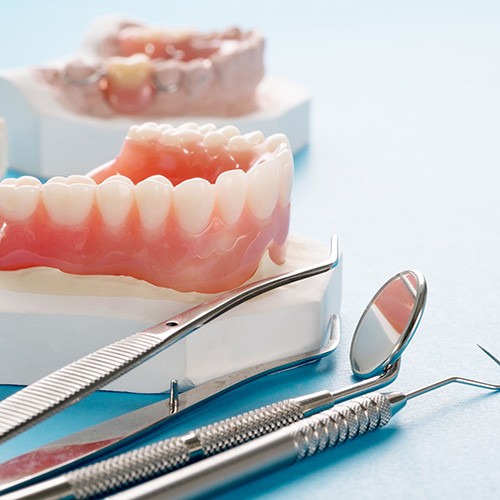
Based on your consultation results, Dr. Smith will suggest one of several types of dentures to you. These kinds include the following:
Partial Dentures
Partial dentures are (per their name) those that only replace a few teeth. Given their design, they either fit over your gumline with suction or clasp onto sturdy “abutments” (i.e., nearby natural teeth). Such methods ensure the denture’s pink acrylic base and color-matched teeth blend with your smile.
Full Dentures
Unlike the partial kind, a full denture replaces an entire arch of teeth at once. The device thus relies on suction force or adhesives; it doesn’t alter nearby teeth with clasps. It still bears similarities to partial dentures, though, as it’s tailored to fit snugly and comfortably over your gums.
Implant Dentures
For patients who want a “permanent” option, implant dentures are ideal. They secure themselves with dental implants – metal posts that fuse with your jaw – instead of clasps or suction. As a result, an implant denture is always secure and stable; it shouldn’t ever slip or fall like a regular one. The device’s implant posts will also prevent (and reverse) facial collapse.
The Benefits of Dentures

Dentures of all types have great benefits that make them worthwhile. For example, some of the most notable ones are:
- Better Nutrition – Dentures provide you with new “teeth,” so they help you chew and eat a wider range of food. This improvement leads to a better diet with higher nutritional health.
- Gorgeous Results – Thanks to their high-quality materials, modern dentures look very realistic. They blend quite seamlessly with the rest of your grin.
- More Confidence – Because dentures restore your smile, they typically leave you with more confidence. Knowing that they “fill” your grin can make you self-assured among friends and family.
- Long-Lasting Savings – On top of their high effectiveness, dentures have a relatively low cost compared to other restorations. They’re thus ideal for patients with limited budgets.
Denture FAQs
What are dentures made from?
It’s natural to have questions about these lifelike restorations, and many patients are curious about what their new teeth are made from. These prosthetics can be made from a variety of materials, and the selections you make can affect their durability and comfort.
For example, the foundation of your dentures can be crafted from acrylic or resin, though the former is the more common option because it can be engineered to be stronger and less likely to crack. The replacement teeth can also be made from resin, but are more commonly created using resilient ceramic, such as porcelain, which reflects light more like enamel and tends to last longer than the alternative.
How are dentures customized?
You’re not alone if you’re worried that your new teeth might look unnatural or bulky, but Dr. Smith and the rest of our team take the time to carefully customize them to look as lifelike as possible, helping improve your appearance and self-esteem.
For example, instead of relying on manual impressions of your mouth that have plenty of room for error, we use advanced digital impressions for improved accuracy and comfort. This information is shared with a dental laboratory, where a technician uses your images and information to carefully carve the base of your restoration to resemble your connective tissues. The artificial teeth, or pontics, are also carefully crafted to match the ones you were born with to boost your confidence.
Can dentures become ill-fitting?
Our team goes through great lengths to ensure that your restoration fits like a glove, but many patients don’t realize that their jawbone starts to thin once teeth go missing. Eventually, as it weakens, the bony ridges under your gum tissues become flatter. This makes it harder for your dentures to create a tight enough suction to remain firmly in place throughout the day, and they may be more likely to become destabilized or dislodged.
If you’re worried that yours don’t fit correctly anymore, you can contact us for an appointment. We can help reline, repair, or replace your dentures so that you can continue making the most of their many benefits.
Can I repair my own dentures?
Broken or damaged dentures may not necessarily be a dental emergency, but you might injure your gums, any remaining teeth, and your bite alignment if you wear them in their current condition. You might feel tempted to try to fix them with superglue or other household supplies, but this typically isn’t recommended because these products aren’t intended for oral use and can be toxic if ingested. Not only that, but you might accidentally make matters worse.
Contact us for an appointment, and we’ll provide potential treatment options to professionally repair or replace your prosthetics safely.